How to choose an AI coding assistant
A practical framework for evaluating AI coding assistants by workflow, reviewability, privacy, and cost.
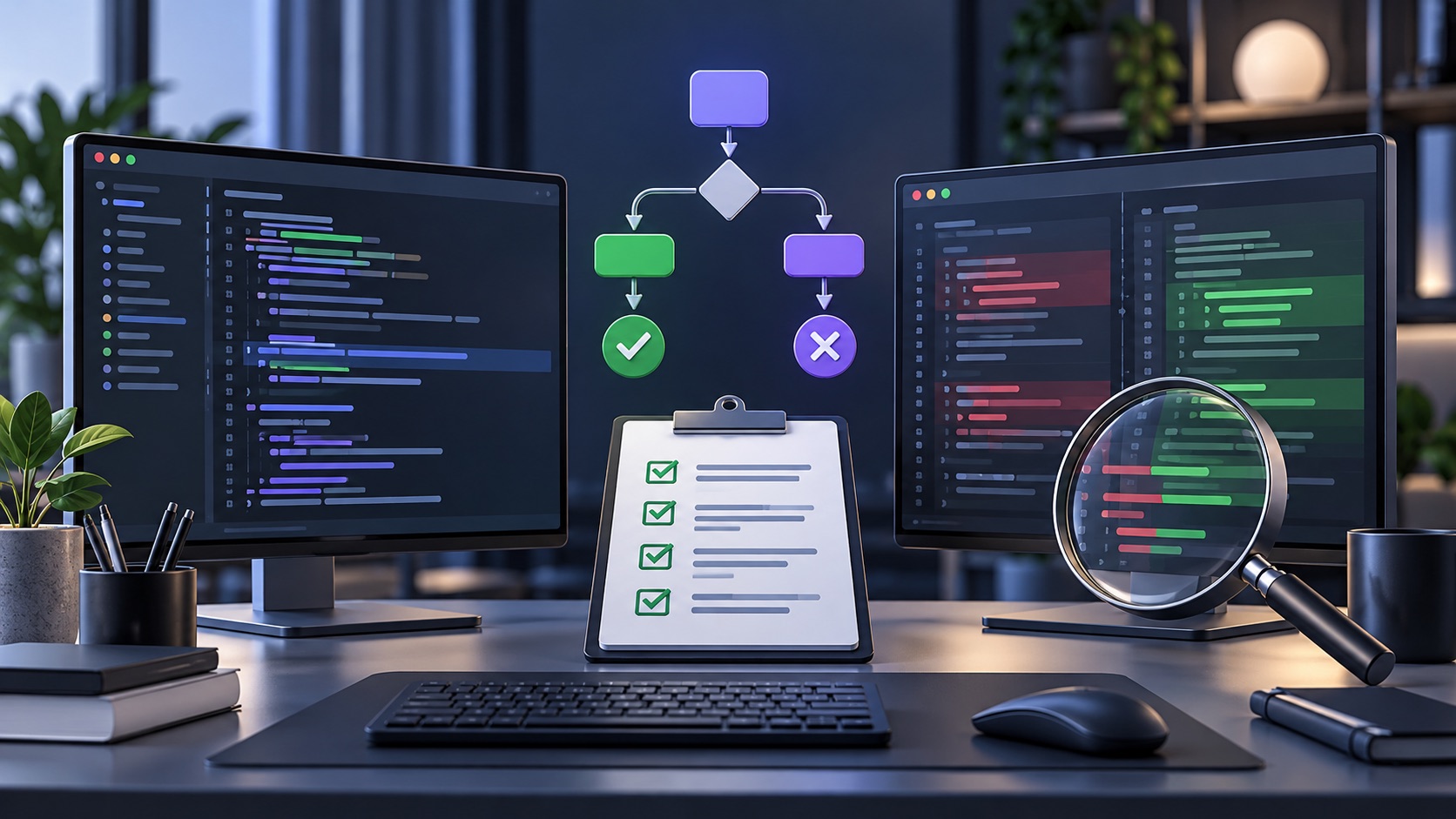
AI coding assistants are easiest to evaluate when they are treated as part of an engineering system, not as a one-click replacement for engineering judgment. A useful choice depends on where work begins, what context the assistant can safely access, and how changes are reviewed before they reach production.
Start with one workflow
Choose a single recurring task for a short trial: explain an unfamiliar module, add a small test, trace a bug, or draft a pull-request description. Give every candidate the same repository snapshot, acceptance criteria, and time limit. Record whether the result is understandable, whether it touched unrelated files, and how much human cleanup it needed. This avoids comparing impressive demos instead of day-to-day output.
Evaluate context and control separately
Context is valuable only when it is appropriate. Ask what files, issue text, terminal output, and repository history the tool can see; then ask who controls that scope. GitHub describes Copilot as an assistant that can work with code, issues, pull requests, and repository automation, while administrators can control access and policy settings. That can be a strong fit for teams already centered on GitHub, but it does not remove the need for review. GitHub Copilot overview
For editors that index a codebase, verify how indexing and prompts are handled. Cursor documents several privacy modes and explains that codebase indexing uploads chunks to compute embeddings; it also documents what is stored and what is not. Treat vendor documentation as a starting point for your own security review, not as a substitute for it. Cursor privacy documentation
Use a review-first trial
Run each generated change through the same safeguards used for human-authored code:
- Read the diff before running it.
- Run tests, linters, and dependency checks locally or in CI.
- Check authentication, authorization, input handling, and secrets explicitly.
- Require a maintainer to approve the pull request.
GitHub’s responsible-use guidance makes the same core point: generated code can look plausible while still being wrong or insecure, so output should be reviewed and tested. GitHub responsible-use guidance
Use the same scorecard for every candidate
Run the trial with the same repository snapshot, issue brief, timebox, and reviewer. A scorecard makes trade-offs visible; it is not a claim that one weighted total is universally correct. Set the weights before looking at results and keep the evidence next to the score.
| Dimension | What to observe | Example evidence |
|---|---|---|
| Task fit | Does it complete a real, bounded task? | Patch, test output, and reviewer notes |
| Context control | Can the team limit files, repos, and connectors? | Policy settings and access test |
| Reviewability | Is the change small, explained, and traceable? | Diff size, rationale, undo path |
| Reliability | Does it handle ambiguity or say it lacks context? | Failure cases and retry record |
| Security | Does it preserve existing controls and avoid unsafe defaults? | Security review and dependency scan |
| Cost | What is the total operating cost? | Seats, usage, CI, review, and rework time |
For each task, record the prompt or instruction, the tool version and model setting where visible, the files made available, elapsed time, tests run, and reviewer outcome. Never use a real secret or privileged production credential as trial context. If a tool can execute commands or modify files, require a sandbox and a human approval boundary for the pilot.
Test failure modes deliberately
The happy path is rarely the operational risk. Give every candidate incomplete requirements, a misleading repository comment, an unfamiliar dependency, and a failing test. Look for whether it states uncertainty, asks a useful question, confines its changes, and leaves the repository in a recoverable state. For agentic tools, also verify which commands, network destinations, and credentials can be reached.
NIST's Secure Software Development Framework provides a useful baseline for keeping security requirements, design decisions, and verification evidence in the delivery process. It is a framework, not a substitute for your engineering judgment. NIST SSDF For AI-specific application threats, use current OWASP GenAI guidance as a review prompt, especially where untrusted content can influence tool calls. OWASP GenAI Top 10
Compare the total operating cost
Subscription price is only one part of cost. Include onboarding time, rate limits, model usage, CI minutes, prompt retries, and the time required to validate output. A tool that produces smaller, reviewable patches can be cheaper than one that produces large changes quickly but creates difficult review work.
Make the decision reversible
Document the chosen tool, approved use cases, prohibited data, and escalation path. Revisit the choice after a defined pilot period using evidence from merged changes rather than anecdote. The best initial adoption is narrow, measurable, and easy to roll back.
A practical decision record
Publish a one-page decision record with the workflow tested, approved repositories, allowed data classes, required human checks, measured benefits, unresolved risks, owner, and a review date. This is more useful than a generic recommendation because it tells the next engineer how the tool may be used safely. Re-run the scorecard after a major model, pricing, permission, or policy change.
This article is an editorial evaluation framework, not a security certification or a guarantee of code quality. Verify product behavior in your own environment and keep normal code review, testing, and incident processes in place.
Run a measured rollout after the pilot
Passing a short trial does not mean every repository should be enabled immediately. Start with teams that have stable tests, active code review, and a clear owner for the workflow being improved. Publish a lightweight usage guide that explains approved repositories, forbidden data, when an agent may edit files, and when it may only propose a change. Include a few good prompt examples, but make the review standard more important than any particular prompt: engineers remain responsible for understanding the diff and for escalating uncertain behavior.
Use ordinary engineering signals to judge the rollout. Compare time from issue to merged change, reviewer effort, defect escape, test coverage, rollback rate, and developer-reported friction for similar classes of work. Separate work accelerated by the assistant from work that would have been simple anyway. Review a sample of accepted and rejected suggestions so that a faster merge does not hide weaker design decisions or a growing dependency on large, hard-to-maintain patches.
Set a checkpoint at which the team can narrow, pause, or expand access. Revisit permissions after a major model, agent, pricing, or privacy change; re-run the failure tests when the tool gains command execution or new connectors. If a tool cannot meet the team’s data boundary or produces changes that reviewers cannot confidently validate, the right outcome may be a limited use case rather than a broader subscription. Reversibility is a sign of disciplined adoption, not a failed evaluation.
Keep the pilot record with the engineering decision, not in a private experiment folder. It should show which tasks improved, which safeguards remained mandatory, and what evidence would justify changing scope. That lets new team members use the tool consistently and gives security, finance, and engineering a shared basis for future renewal decisions.
Review the record after the first production month, when real constraints are visible.